Business prospecting
LeadForge
Find local businesses with a clear reason to reach out.
LeadForge is a self-hosted prospecting workspace for teams that sell to small and local businesses. It combines public-source discovery, website checks and an outreach pipeline so teams can research and qualify prospects in one place.
View screenshots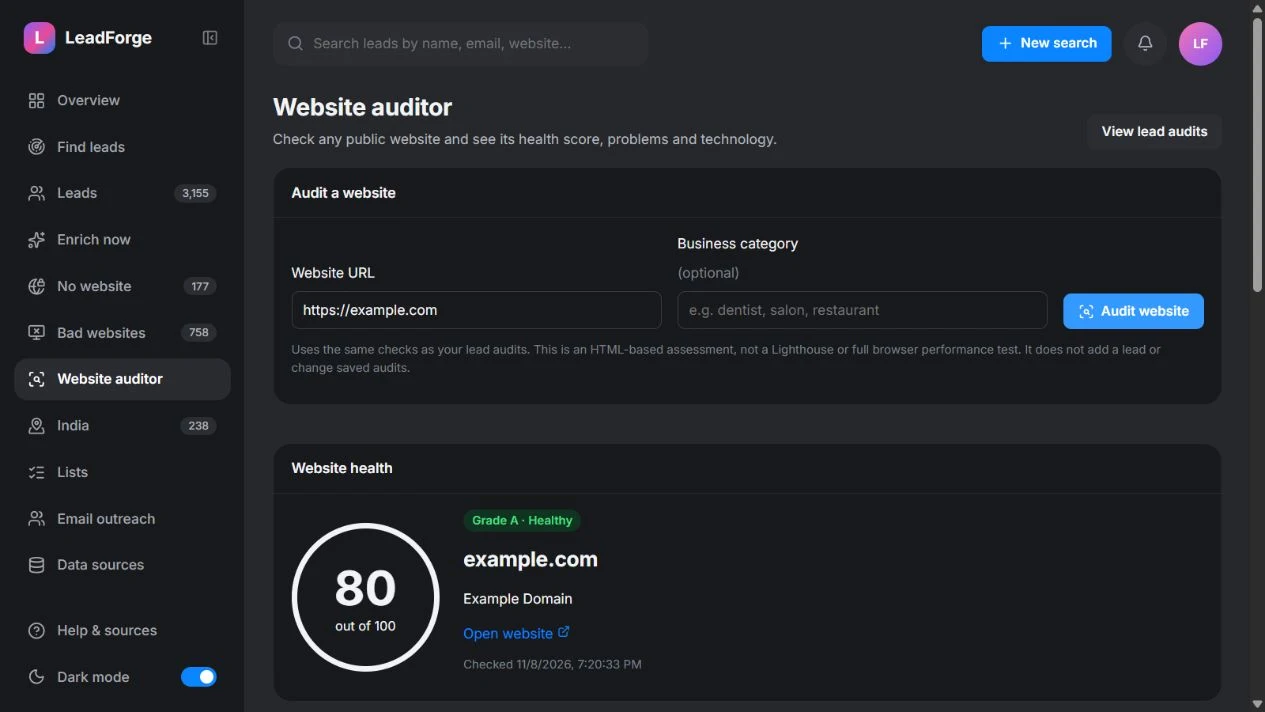
Project case study
The problem
Finding a local business and knowing what to do with that lead are two different jobs. A directory can tell a sales team that a business exists, but it rarely explains whether the business has a usable website, whether it can be reached, or what the first conversation should cover. LeadForge brings those questions together in a workspace for teams that sell to small and local businesses.
From search to a working list
A search starts with a market, business category and location. Operators can choose sources for India, Australia or the United States alongside worldwide map directories. Different sources serve different purposes. A map listing helps find businesses by category and city, while a company register can surface recently formed businesses. The results remain attached to the search that produced them, so reopening a search shows its recorded membership even if records are later found elsewhere.
When a listing matches an existing business, LeadForge reuses the record and links it to the new search. That lets an operator see where a prospect was found without maintaining multiple copies of the same business. The Leads view adds filters for market, contact details, status and enrichment, and operators can create lists for a campaign or a follow-up batch.
Finding a specific reason to reach out
LeadForge offers separate views for reachable businesses with no website and businesses whose websites may need work. The website auditor checks signals such as HTTPS, mobile setup, load time and contact options. The audit screenshot uses example.com to show how a health score is presented alongside findings an operator can inspect. A finding gives the operator a starting point for reviewing the site and deciding whether the issue belongs in a conversation.
The lead drawer keeps source information, contact details, notes, lists, status and the latest website review together. For example, an operator researching local clinics could open a record, review a contact-form or booking finding, and add the business to a campaign list before drafting a message.
How it is built
LeadForge runs as a React and Vite frontend with an Express API. SQLite serves as the default store, with PostgreSQL available as an option. Search and enrichment run as background jobs, so operators can keep working while records are processed. Signed-in accounts have separate leads, searches, lists and Gmail connections. The scoring model prioritises records with usable business and contact information, while the website health score evaluates the site itself.
More screenshots